
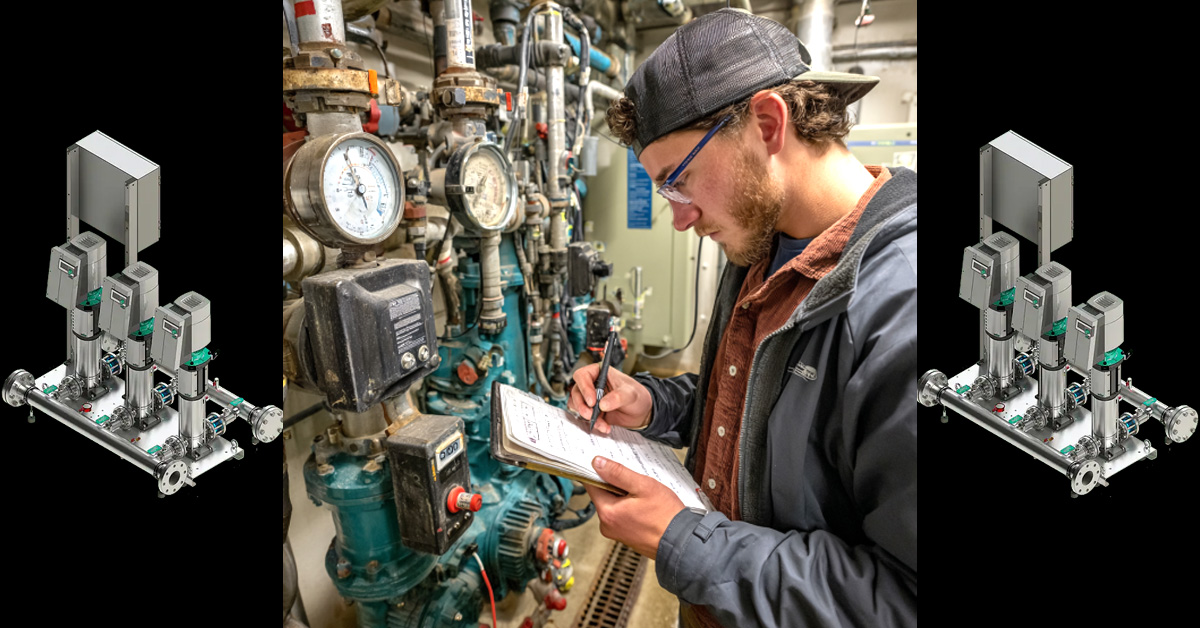
Sizing a Wilo Package Booster System: what engineers and contractors need to know before the spec is written.
Booster system sizing is more than picking a pump. The engineers and contractors who get into trouble on commercial water pressure applications are usually the ones who started with a pump and worked backward. Flow demand, pressure requirements, duty and standby configuration, inlet conditions, controls integration, and installation constraints all need to be understood before a booster system can be specified correctly. Here is how we think through it with engineers and contractors before the order is placed.
Start with the pressure deficit, not the pump
The first question in any booster system application is not what pump to use. It is what pressure deficit needs to be overcome. Municipal supply pressure at the meter is the starting point, but that number is not the design pressure. Supply pressure fluctuates based on time of day, seasonal demand, and utility infrastructure conditions. The design inlet pressure for a booster system should be based on the minimum expected supply pressure, not the average or maximum. Designing to an optimistic inlet pressure that does not hold during peak demand periods is one of the most common ways a booster system ends up underperforming after installation.
From there, the required discharge pressure is determined by the most demanding fixture or zone in the building at its highest elevation, plus the friction losses in the distribution piping between the booster and that fixture. In a multi-story building, every floor adds approximately 0.43 PSI of static pressure requirement per foot of elevation. A fifteen-story building with a 45-foot height difference between the booster and the top-floor fixtures is adding roughly 20 PSI to the required discharge pressure before friction losses are even accounted for.
Flow demand and the peak load problem
Flow demand sizing requires understanding when the building draws water and how much it draws at peak. A hotel has a very different demand profile than an office building, which has a very different profile than a hospital. Sizing a booster system for average demand produces a system that cannot meet peak load. Sizing for absolute peak demand with a single pump produces a system that operates at poor efficiency for most of its service life.
This is where multi-pump configurations earn their place in commercial applications. The Wilo WiBooster is available in two, three, and four-pump configurations with variable frequency drives on each pump. In a multi-pump system, pumps stage on and off based on actual demand, with VFD control allowing each active pump to operate at its best efficiency point across the full range of building loads. The system delivers what the building needs without running all pumps at partial load continuously.
“Booster system sizing is more than picking a pump. The engineers who get this right start with the pressure deficit and the demand profile, not the catalog page.”
Duty and standby configuration
Duty and standby pump configuration is a decision that needs to be made explicitly, not defaulted into. In a two-pump system, running both pumps in duty without a standby means a single pump failure takes the system offline. In applications where continuous water pressure is operationally critical, a duty and standby arrangement where one pump serves as a redundant backup is the right specification. In applications where temporary pressure reduction during a pump service event is acceptable, a lead-lag arrangement where both pumps share the load may be more appropriate.
The WiBooster PLC controls support both configurations, along with automatic fault-actuated switchover so the standby pump comes online without manual intervention when the duty pump faults. That automatic switchover is the feature that protects the building when something fails at two in the morning.
WiBooster specifications for commercial applications
| Parameter | WiBooster specification |
|---|---|
| Pump configurations | 2, 3, or 4 pump |
| Max operating pressure | 150 PSI |
| Max inlet pressure | 75 PSI |
| Fluid temperature range | 40°F to 140°F |
| Ambient temperature range | 32°F to 104°F |
| Wetted components | 304 stainless steel construction |
| Certifications | NSF-61 and NSF-372, UL listed as packaged pumping system |
| Controls | PLC-based with VFD on each pump, real-time diagnostics, remote monitoring |
| Switchover | Automatic fault-actuated switchover between duty and standby |
Inlet conditions and installation constraints
Two installation factors that are often overlooked until they become problems on site: inlet pressure and available space. The WiBooster is rated for a maximum inlet pressure of 75 PSI. In buildings where the municipal supply pressure regularly exceeds that at the meter, a pressure reducing valve upstream of the booster is required. That PRV needs to be part of the specification, not an afterthought discovered during startup.
Space is the other variable. A four-pump WiBooster in a configuration sized for a large commercial building is a substantial piece of equipment. The mechanical room needs to accommodate not just the booster skid itself but the required service clearances, the inlet and discharge piping connections, the electrical supply, and the drainage for potential maintenance activities. Confirming these constraints before the equipment is ordered prevents the installation problems that generate callbacks.
The conversation to have before the spec is written
When a contractor or engineer brings us a commercial booster application, the questions we ask are not about which model to order. They are about the building. What is the minimum expected inlet pressure? What is the peak flow demand and when does it occur? What are the highest fixture elevations and the longest pipe runs? Is continuous pressure availability operationally critical or is brief interruption acceptable during service? Are there any fluid temperature conditions that fall outside the standard range?
Those answers drive the specification. Merion Pump represents Wilo across Eastern Pennsylvania, Southern New Jersey, and Delaware. If you have a commercial booster application in development, bring us those inputs before the spec is written and we will help you get the sizing right the first time.
References
1. Wilo USA. Wilo-WiBooster Product Page and Submittal Data. Covers WiBooster configurations, pressure ratings, certifications, controls specifications, and hydraulic data. wilo.com/us/en_us/Products/en/products-expertise/wilo-wibooster
2. Wilo USA. Selecting a Multi-Pump Pressure Booster System. Wilo’s published guidance on multi-pump booster system selection for commercial applications. wilo.com/us/en_us/Training/On-Demand-Resources/Pump-Basics/Selecting-a-Multi-Pump-Pressure-Booster-System
3. Hydraulic Institute. Pump System Optimization Guide. Covers variable speed operation, best efficiency point selection, and multi-pump staging in commercial pressure booster applications. pumps.org
4. ASHRAE. ASHRAE Plumbing Engineering Design Guide. Covers domestic water pressure requirements, fixture unit calculations, and booster system design considerations for commercial buildings. ashrae.org