
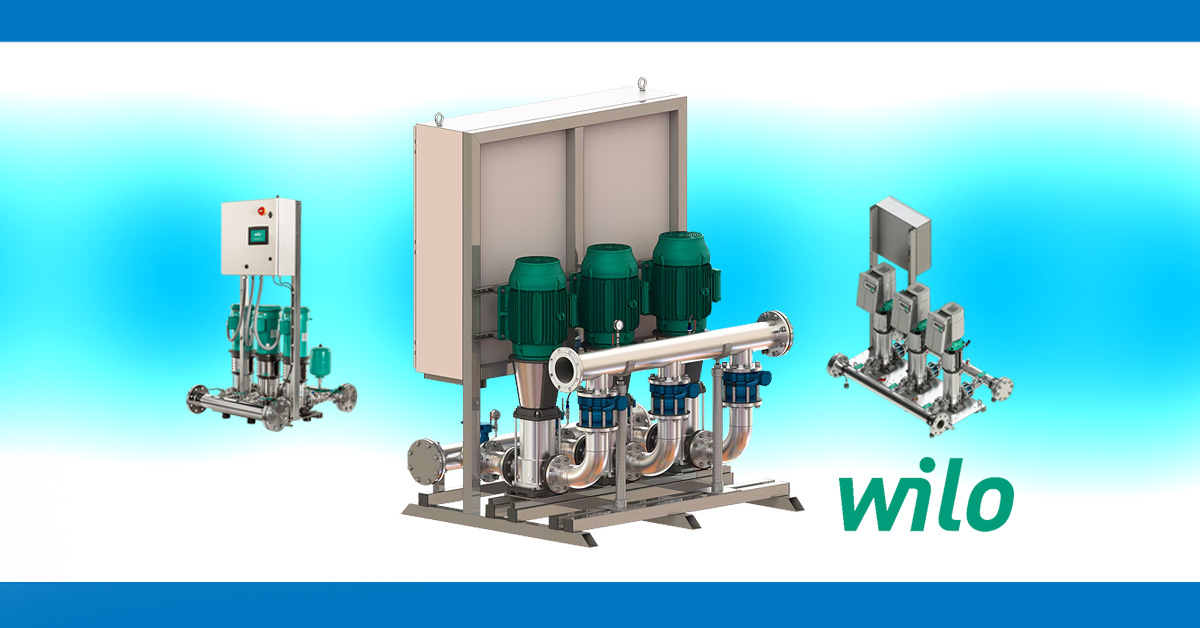
Introducing Wilo package booster systems for commercial water pressure applications
When a building’s municipal supply pressure is not enough, a package booster system is the answer. Here is what Wilo brings to that application and why it belongs on your spec list.
The problem every multi-story building has
Municipal water pressure is designed to get water to the street. What happens inside the building after that is the engineer’s problem. In a single-story structure it usually is not a problem at all. In a mid-rise office building, a hotel, a hospital, or any facility where water needs to travel vertically and supply multiple simultaneous use points, inadequate pressure is a daily reality that a properly specified booster system solves once and keeps solving for years.
The challenge with a single constant-speed pump is that pressure and flow work against each other. As demand increases, pressure drops. Oversize the pump and you waste energy during off-peak hours. Undersize it and you overwork the system at peak demand. A multi-pump variable speed package booster system resolves both problems by matching system output to actual demand in real time.
That is the application Wilo has engineered their package booster line to address, and it is a solution we are now bringing to engineers and contractors across the Delaware Valley through Merion Pump Company.
The Wilo package booster lineup
Wilo offers two primary package booster system configurations suited to commercial applications.
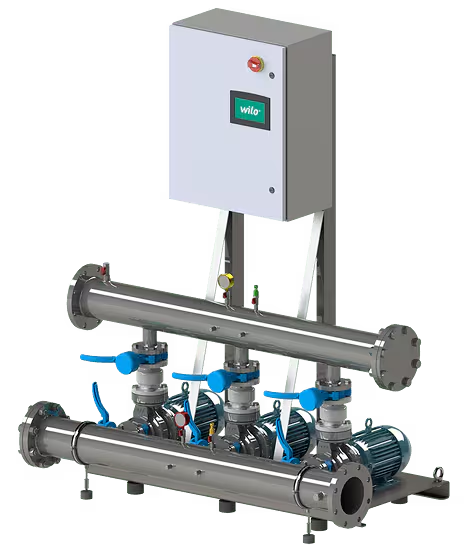
WiBooster
The WiBooster is Wilo’s entry-level commercial packaged booster, built for domestic water pressure applications in standard commercial buildings. Available in 2, 3, or 4-pump configurations. VFD-controlled system operation with variable speed control and balanced run time across all pumps. All wetted components are 304 stainless steel construction. NSF 61 and NSF 372 listed for drinking water. UL QCZJ listed for packaged pumping systems. Rated pressure 150 PSI. Fluid temperature range -4°F to 140°F with a minimum of 32°F for domestic water. 150 Class ANSI flange connections. Premium efficient NEMA motors.
Best for: Hotels, office buildings, apartment buildings, schools, and commercial facilities with standard domestic water pressure requirements where the municipal supply is insufficient to maintain consistent pressure at all delivery points.
CO-Helix
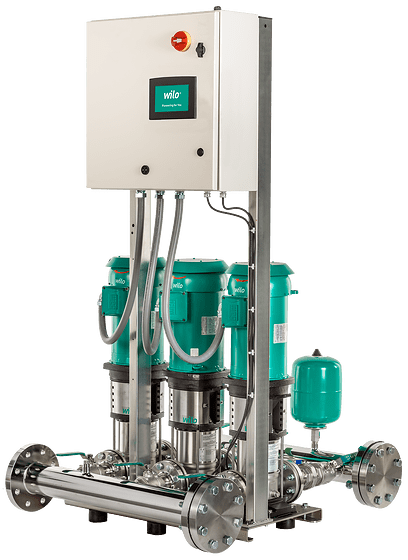
CO-Helix
The CO-Helix is Wilo’s higher-performance commercial and industrial packaged booster system, built on the Wilo-Helix V pump platform with PLC controls built in-house at Wilo’s production facility in Cedarburg, Wisconsin. Available in 2, 3, or 4-pump configurations. PLC-based control with real-time diagnostics and remote monitoring. Variable speed control with balanced run time for each pump. Maximum head 580 feet. Maximum flow 1,600 GPM depending on configuration. Rated pressure 232 to 363 PSI. Full 304 stainless steel construction. NSF 61 and NSF 372 certified. 300 Class ANSI flange connections. Fluid temperature range -4°F to 248°F. Hydrostatically tested prior to shipment.
Best for: High-rise buildings, hospitals, large commercial campuses, industrial facilities, and any application where higher pressure ratings, greater flow capacity, or more demanding duty cycles are required. The remote monitoring capability makes the CO-Helix particularly well suited for critical facilities where uptime is non-negotiable.
What variable speed control actually means for the building
This is worth spending a moment on because it is the feature that engineers and facility managers most often undervalue at spec time and most appreciate after installation.
A constant speed pump runs at full power regardless of demand. At 2am when two people are running water in a 200-room hotel, the pump is still running at full capacity. That wastes energy, generates unnecessary wear, and creates pressure spikes that stress the system.
A VFD-controlled multi-pump system stages pumps on and off as demand changes and trims motor speed to match actual system requirements. The result is consistent pressure at every delivery point regardless of how many people are using water simultaneously, lower energy consumption across the operating cycle, quieter operation, and extended equipment life.
For a facility manager, that translates to fewer service calls, lower utility bills, and a system that behaves the same on a Tuesday afternoon with full occupancy as it does on a Sunday morning with a skeleton crew.
Spec considerations engineers should know
A few things worth flagging before the specification is written:
NSF 61 and NSF 372 certification is standard across the Wilo package booster line. Both the WiBooster and CO-Helix carry full UL QCZJ listing for packaged pumping systems. If the project spec requires certified drinking water components, this is already addressed.
Suction and discharge manifolds include pressure transducers and analog pressure gauges as standard equipment. The discharge manifold includes a shutoff valve. These details matter when coordinating with mechanical drawings.
All manifolds are 304 stainless steel construction. For facilities where corrosion resistance and long service life are specification criteria, this is worth calling out explicitly in the spec language.
The CO-Helix includes full system kWh energy reporting. For projects pursuing LEED certification or for owners who track operating costs, this is a specification feature that adds value beyond the installation.
Pump warranty is two years from date of installation, not to exceed six months from date of purchase on the CO-Helix. Factor this into commissioning and substantial completion timelines.
Applications we see most often in this market
In the Delaware Valley market, package booster systems come up most frequently on these project types: mid-rise and high-rise office buildings where upper floors cannot rely on municipal pressure, hotel and hospitality projects where consistent guest experience depends on pressure stability across all floors and peak check-in periods, healthcare facilities where water pressure reliability is tied to patient care and facility operations, university and campus buildings with high simultaneous demand, and mixed-use developments where domestic water and irrigation systems need separate pressure zones.
If your project fits any of these categories and you have not yet had a booster system conversation, it is worth having before the design is locked.
Why Merion Pump for this application
We do not just sell equipment. We sit with engineers before the spec is written, help size the system correctly for the application, and make sure the right configuration ends up in the drawing set. For booster applications that means walking through peak demand calculations, pressure zone requirements, pump staging logic, and long-term maintenance considerations before anyone commits to a product.
Wilo is a manufacturer whose engineering depth and product quality we stand behind. The PLC controls are built in-house, the stainless steel construction is standard rather than an upgrade, and the remote monitoring capability is built into the platform rather than bolted on as an afterthought.
If you have a commercial project with a water pressure challenge, reach out before the design is finalized. That conversation is free. Getting it wrong at the spec stage is not.
Merion Pump Company — info@merionpump.com — merionpump.com
Serving eastern PA, southern NJ, and Delaware.
References
1. Wilo USA. Booster Systems. Package booster system configurations, VFD control, NSF certifications, and pressure ratings for commercial applications. wilo.com/us/en_us/Solutions/Pump-Solutions/Booster-Systems
2. Wilo USA. Wilo-WiBooster Product Page. WiBooster specifications including rated pressure, 304 stainless steel construction, UL QCZJ listing, NSF 61 and NSF 372 certification, and domestic water temperature ratings. wilo.com/us/en_us/Products/en/products-expertise/wilo-wibooster
3. Wilo USA. Wilo-CO MVI Product Page. CO-Helix specifications including rated pressure, maximum head and flow, 300 Class ANSI flange connections, and full system kWh energy reporting. wilo.com/us/en_us/Products/en/products-expertise/wilo-co-mvi
4. Wilo USA. CO-Helix Engineering Specification. Detailed specification language covering manifold construction, pressure transducers, hydrostatic testing, warranty terms, and installation requirements. cms.media.wilo.com/dcidocpfinder/wilo200251/7188674/wilo200251.pdf
5. Wilo USA. Selecting a Multi-Pump Pressure Booster System. Technical guide covering variable speed staging, constant speed limitations, peak demand management, and building pressure zone applications. wilo.com/us/en_us/Training/On-Demand-Resources/Pump-Basics/Selecting-a-Multi-Pump-Pressure-Booster-System
6. Hydraulic Institute. Pump System Optimization Guide. Industry reference covering energy efficiency standards and variable speed operation for commercial pump applications. pumps.org