
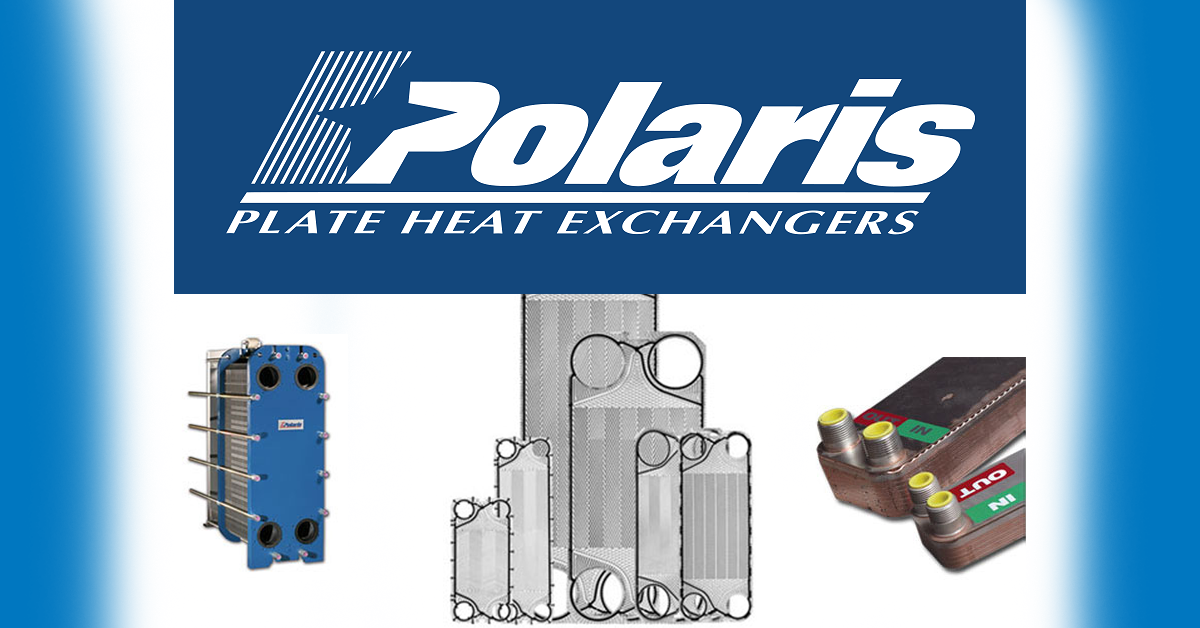
Polaris plate heat exchangers: complete product overview and application guide.
Polaris manufactures a complete line of plate heat exchangers for commercial and industrial hydronic applications. Merion Pump Company represents Polaris across the Mid-Atlantic region. This article covers the full Polaris product line, the configurations available, and the applications each product is designed to serve.
For engineers who read our earlier introduction to Polaris plate heat exchangers, this article goes deeper into the product configurations and application matching. For engineers encountering Polaris for the first time, it provides the full picture before a project conversation begins.
What a plate heat exchanger does differently
A plate heat exchanger transfers heat between two fluid streams across a series of corrugated metal plates rather than through a bundle of tubes inside a shell. The corrugated plate geometry creates turbulent flow conditions at low fluid velocities, which produces high heat transfer coefficients with a compact physical footprint. The result is a heat exchanger that achieves the same thermal duty as a shell and tube unit in a fraction of the space and at a lower weight.
For commercial hydronic applications where mechanical room space is constrained and where the heat exchanger is part of a system that needs to be maintained by facility staff rather than specialized process engineers, the plate heat exchanger format offers practical advantages beyond the thermal performance numbers. The plates are accessible for inspection and cleaning without special tooling. The capacity can be adjusted by adding or removing plates within the frame. The unit can be disassembled in the field without lifting equipment.
The gasketed plate and frame line
The Polaris gasketed plate and frame heat exchanger is the standard product for commercial hydronic applications including building heating, domestic hot water generation, pool heating, geothermal heat exchange, and district energy interface applications. The gasketed design uses elastomeric gaskets to seal the plates within a bolted frame, allowing the unit to be opened for inspection, cleaning, and plate replacement without special tooling.
Polaris gasketed units are available in a range of frame sizes and plate counts to cover the thermal duty and flow rate requirements of commercial applications from small building heating systems through large district energy interfaces serving campus facilities. The plates are available in stainless steel as the standard material with titanium and other high-alloy materials available for applications where the fluid chemistry requires enhanced corrosion resistance.
For domestic hot water heating applications, the Polaris gasketed unit provides an efficient interface between the building heating hot water system and the domestic water circuit. The gasketed design allows the unit to be opened for periodic cleaning to remove mineral scale that accumulates on the plate surfaces in hard water applications, which is more practical than the chemical cleaning required for a fouled brazed plate unit that cannot be opened.
The brazed plate line
The Polaris brazed plate heat exchanger is a compact, all-stainless construction unit where the plates are copper-brazed together rather than gasketed and bolted. The brazed construction eliminates the gaskets, produces a unit that is smaller and lighter than a gasketed equivalent, and allows operation at higher pressures and temperatures than elastomeric gaskets permit.
Brazed plate units are well suited to applications where the compact footprint is the primary selection criterion, where the operating pressure or temperature exceeds the gasketed unit’s gasket material limits, and where the fluid chemistry is not so aggressive that a gasketed unit with field-cleanable plates is required. Refrigeration applications, heat pump interfaces, and compact domestic hot water generation are common brazed plate applications in the commercial building services market.
The limitation of the brazed construction is that the unit cannot be opened for cleaning or plate inspection. A brazed plate unit that has fouled must be chemically cleaned in place or replaced. For applications where the water chemistry is aggressive or where the scaling potential is high, the gasketed plate and frame unit’s field-cleanable design is the more appropriate specification.
The semi-welded line for aggressive applications
The Polaris semi-welded plate heat exchanger pairs welded plate cassettes on one side of the unit with gasketed connections on the other. The welded side handles the more aggressive fluid, such as a refrigerant, ammonia, or a process fluid with chemistry that would attack elastomeric gaskets, while the gasketed side handles the utility fluid such as water or glycol.
For commercial and industrial applications where one side of the heat exchanger carries a fluid that a standard gasketed unit cannot handle, the semi-welded design provides the chemical resistance needed on the process side while retaining the field-serviceable gasketed design on the utility side. Heat pump applications with refrigerant on one side and water on the other, ammonia refrigeration systems interfacing with a water-based secondary loop, and process applications with aggressive chemistry on the process side are typical semi-welded applications.
Application matching summary
The selection between gasketed plate and frame, brazed plate, and semi-welded configurations comes down to four factors: operating pressure and temperature requirements, fluid chemistry on both sides of the heat exchanger, fouling potential and the need for field-cleanable plates, and physical footprint constraints.
Gasketed plate and frame is the standard commercial specification for building heating, domestic hot water, pool heating, and district energy interface applications where the fluids are water or water-glycol, the pressure and temperature are within standard commercial HVAC ranges, and periodic cleaning access is valued.
Brazed plate is the specification for compact footprint requirements, higher operating pressure, refrigeration and heat pump interfaces, and applications where the operating conditions exceed what elastomeric gaskets can handle and where the fluid chemistry does not create a fouling problem that requires periodic cleaning access.
Semi-welded is the specification for applications where one side of the heat exchanger carries a fluid that would attack elastomeric gaskets, including refrigerants, ammonia, and process chemicals.
For boiler plant applications where the Polaris heat exchanger serves as the interface between the primary boiler loop and the building secondary distribution, the GP Energy Products team handles the boiler plant side of the application. Visit gpenergyproducts.com for more. For applications where the heat exchanger is part of a packaged system, FabPro Systems handles the packaged system design and can coordinate the Polaris selection with the overall system requirements. Visit fabprosystems.com for more.
References
1. Polaris. Complete product documentation including gasketed plate and frame, brazed plate, and semi-welded configurations, plate material options, and application guidance. polarisphx.com
2. ASHRAE. HVAC Systems and Equipment Handbook, Chapter on Heat Exchangers. Covers plate heat exchanger selection criteria, application matching, and performance characteristics for commercial hydronic systems. ashrae.org
3. TEMA. Standards for Shell and Tube Heat Exchangers. Provides the comparison basis for plate heat exchanger application selection versus shell and tube designs. tema.org
4. NSF International. NSF/ANSI Standard 61. Covers certification requirements for heat exchangers in potable water contact applications including domestic hot water generation. nsf.org