
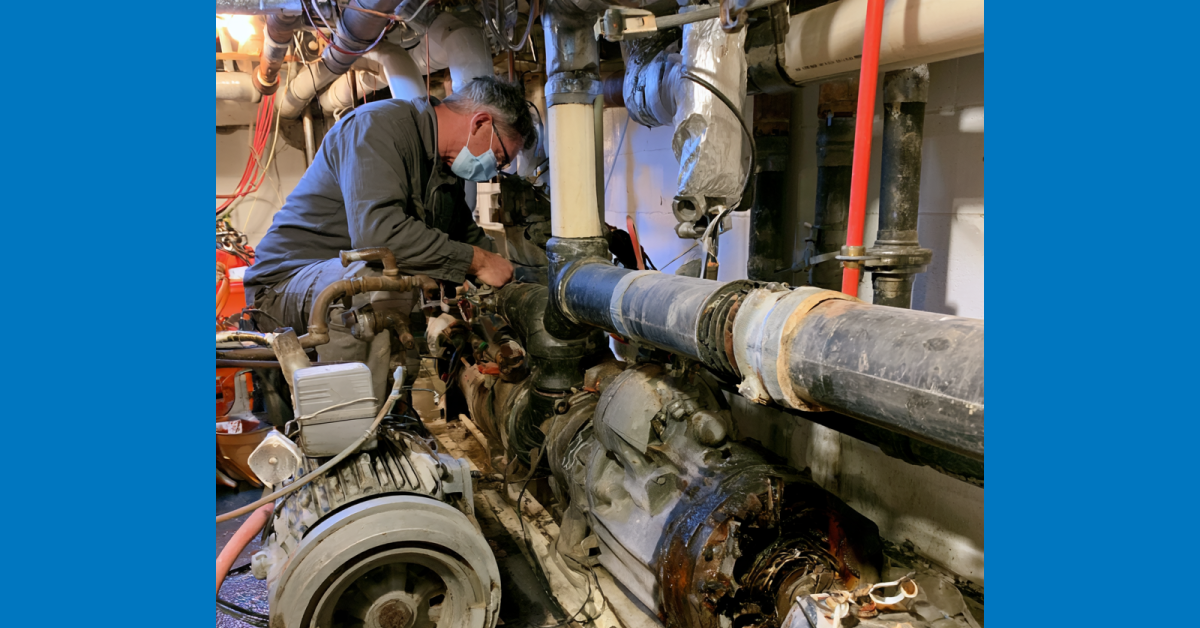
Pump replacement versus repair: the decision framework for commercial hydronic pumps.
The repair versus replace decision for a commercial hydronic pump follows the same logic as the boiler end of life decision: at some point the cost and risk of keeping the existing equipment in service exceeds the cost of replacing it. For pumps, that point is often less obvious than for boilers because pump failures tend to be more gradual and less dramatic, and because the cost of a pump failure is sometimes absorbed as a maintenance expense rather than recognized as a capital decision.
The facility manager who approaches pump replacement as a reactive decision, replacing pumps after they fail, is managing the most expensive version of the pump lifecycle. The facility manager who approaches it as a proactive capital decision, identifying pumps approaching end of life and replacing them on a planned schedule, is managing a predictable cost with predictable outcomes.
What drives pump end of life
Commercial hydronic pumps do not have a fixed service life. A pump that has been well maintained, correctly applied, and operating in a properly treated hydronic system may provide 20 or more years of service. A pump that has been cavitating, running with inadequate lubrication, or operating in a system with aggressive water chemistry may reach end of life in a fraction of that time.
The components that most commonly drive pump end of life decisions are the wear ring clearances, the impeller condition, the mechanical seal, the bearing housings, and the shaft. These are all components that degrade over time and that can be replaced individually or in combination. The question is not whether they can be replaced but whether replacing them is the right economic decision relative to the cost and capability of a new pump.
The wear ring clearance assessment
Wear rings maintain the clearance between the rotating impeller and the stationary pump casing. As the wear rings erode over time, the clearance increases and the internal recirculation from the discharge side of the impeller back to the suction side increases. This recirculation reduces the pump’s effective output for the same shaft input, which shows up as reduced flow at the operating pressure and as increased motor amperage for the same flow.
A pump whose wear ring clearances have opened significantly is producing less flow than it was designed for and consuming more energy to do it. Replacing the wear rings restores the original clearances and the original performance. The question is whether wear ring replacement on an aging pump with other developing issues is a worthwhile repair or whether the pump should be replaced.
For pumps where the wear ring clearances are the only significant issue and where the impeller, shaft, and casing are in good condition, wear ring replacement is almost always the right repair decision. For pumps where the wear rings need replacement and the impeller shows erosion damage, the shaft shows deflection or corrosion, and the bearing housings show wear, the cumulative repair cost needs to be compared against the replacement cost.
The impeller condition assessment
Impeller erosion from cavitation is one of the most common causes of pump performance degradation in commercial hydronic systems. Cavitation occurs when the local pressure at the impeller inlet drops below the vapor pressure of the fluid, causing vapor bubbles to form and collapse on the impeller surface. The bubble collapse is energetic enough to remove material from the impeller over time, changing the impeller’s hydraulic profile and reducing its performance.
A pump that has been cavitating can show impeller erosion within months of installation if the system conditions causing the cavitation are not corrected. Replacing the impeller without correcting the system conditions that caused the cavitation produces a new impeller that will erode on the same schedule as the original.
Identifying and correcting the cavitation cause, whether it is inadequate net positive suction head, a partially blocked suction strainer, excessive system resistance, or a control valve configuration that causes pressure fluctuations at the pump suction, is part of the repair decision rather than a separate issue.
Repair cost versus replacement cost framework
The quantitative framework for the pump repair versus replace decision compares the cost of bringing the existing pump back to acceptable operating condition with the cost of a replacement pump over a defined evaluation period.
The repair cost should include all components that need replacement now and a realistic estimate of the components that are likely to need replacement within the next two to three years based on the current condition assessment. A pump that needs wear rings today and whose bearing housings show wear that will require replacement within two years has a two to three year repair cost that includes both items, not just the wear rings.
The replacement cost should include the pump, motor, and coupling, the installation labor, and any system modifications required to install the replacement pump. For direct replacement of a pump with the same configuration, the installation cost is typically lower than for a pump that requires piping modifications.
For pumps where the replacement offers a meaningful efficiency improvement over the existing pump, the energy cost savings from the more efficient replacement contribute to the replacement side of the calculation. A variable speed pump replacing a fixed speed pump in a variable flow system produces energy savings that can be significant over the evaluation period.
When the system has changed
A pump replacement is also the opportunity to correct a pump that was never correctly sized for the system. A pump that has been throttled by a partially closed discharge valve since installation was oversized for the system. A pump that has been running at the end of its curve, producing low head and high flow, may be undersized for the current system resistance. Replacement with a correctly sized pump eliminates the efficiency penalty of incorrect sizing and may improve system performance as well as reducing energy consumption.
For pump replacement projects where the Merion Pump Company team is involved in the selection, the system curve is analyzed against the pump curve to confirm that the replacement pump is correctly sized for the current system rather than simply matched to the nameplate of the existing pump.
For pump replacement projects where the boiler plant side of the system is also under evaluation, the GP Energy Products team handles the boiler assessment and can coordinate the pump replacement with the boiler plant review. Visit gpenergyproducts.com for more. For pump replacement projects where the replacement is best delivered as part of a packaged pump skid rather than a single pump installation, FabPro Systems handles packaged pump system design and fabrication. Visit fabprosystems.com for more.
Merion Pump Company handles pump replacement and repair assessment for commercial hydronic applications across Pennsylvania, New Jersey, Delaware, and Maryland. Reach out before the repair decision is made and we will work through the replacement versus repair framework for the specific pump and system.
References
1. Hydraulic Institute. Pump Life Cycle Costs: A Guide to LCC Analysis for Pumping Systems. Covers the quantitative framework for pump repair versus replace decision including lifecycle cost methodology. pumps.org
2. ASHRAE. HVAC Systems and Equipment Handbook, Chapter on Pumps. Covers pump wear mechanisms, performance degradation assessment, and replacement criteria for commercial hydronic applications. ashrae.org
3. Hydraulic Institute. Pump Installation, Operation, and Maintenance Standards. Covers wear ring clearance assessment, impeller condition evaluation, and repair decision criteria. pumps.org
4. US Department of Energy. Pumping Systems Tip Sheet. Covers pump efficiency assessment and replacement decision methodology for commercial building applications. energy.gov