
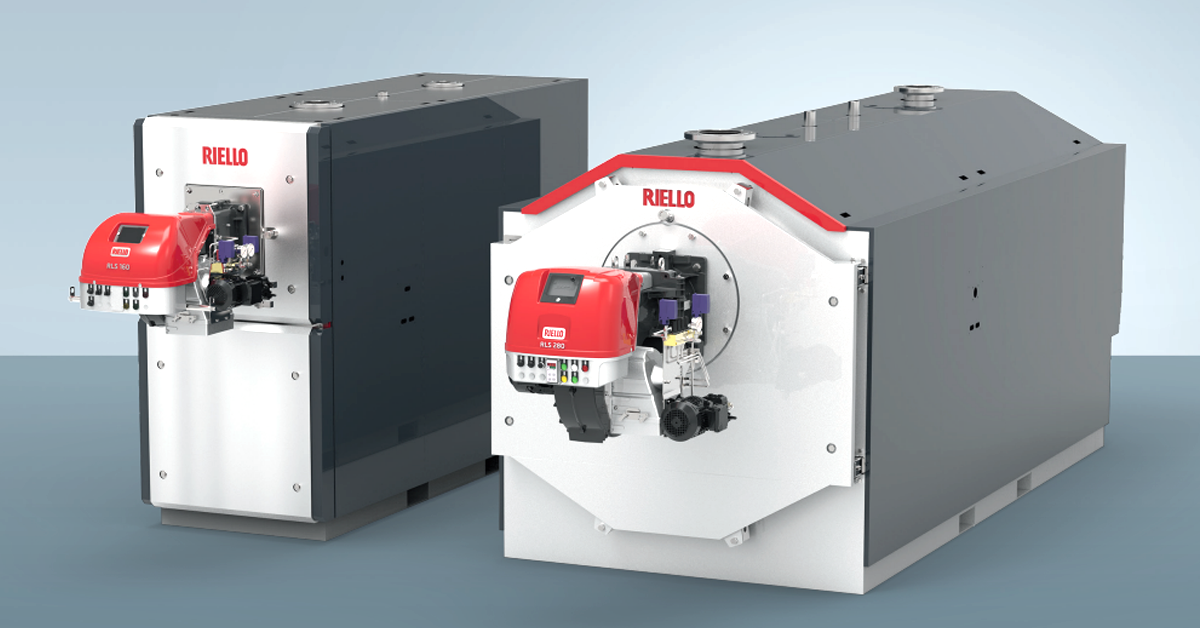
The Riello RTC condensing boiler: high efficiency at commercial scale.
Most conversations about condensing boiler efficiency happen at the residential or light commercial scale. Small buildings, low loads, relatively straightforward installations. The efficiency argument is easy to make when the equipment is simple and the payback period is short.
The Riello RTC makes that same argument at a scale most condensing boilers cannot reach. 3,000 to 10,000 MBH. Buildings and facilities where the heating load is substantial, the fuel consumption is significant, and the difference between 80% and 94% efficiency shows up as a real number on a real utility bill.
What 94% actually means at commercial scale
The RTC carries a 94% AHRI thermal efficiency rating across the full product line. At peak conditions it reaches 98%. Those numbers are verified against AHRI Standard BTS-2000, not claimed from a controlled test environment.
The 10:1 turndown ratio means the boiler modulates from 10% to 100% of its rated input, maintaining high efficiency across the full range of building load conditions rather than cycling on and off at part load. A boiler that cycles constantly to maintain setpoint wastes energy at every startup and shutdown. A boiler that modulates continuously does not.
What makes the RTC genuinely different from conventional condensing boilers at this scale is the minimum flow requirement. It is zero. No dedicated boiler circulator required. No primary-secondary piping arrangement to ensure minimum flow protection. The boiler connects directly to the distribution system, simplifying the installation and reducing the mechanical room footprint.
What is inside the boiler
The RTC uses a 3-pass fire tube heat exchanger with a 316Ti stainless steel combustion chamber, inversion tube, and tube sheets. The fire tubes are 316L stainless. The counter-flow heat exchanger design and dual return water connections maximize condensation across the full operating range, which is what pushes efficiency toward the 98% peak.
The boiler handles natural gas, propane, and dual fuel with number 2 fuel oil backup. NOx emissions stay below 30 ppm at all firing rates on natural gas. It carries ASME Section IV, ETL, and AHRI certifications and produces qualifying points toward LEED certification.
Models run from the RTC 3000 through the RTC 10000. Input ranges from 300 MBH at minimum on the 3000 to 10,000 MBH at maximum on the 10000. Maximum working pressure is 160 PSI. Maximum working temperature is 195 degrees Fahrenheit.
The installation story
Zero minimum flow changes how this boiler installs. In a conventional condensing boiler installation, the engineer specifies a dedicated boiler circulator and primary-secondary piping to protect the boiler from low flow conditions. That adds cost, adds equipment, and adds complexity to the mechanical room.
The RTC eliminates that requirement entirely. The high water content heat exchanger design handles zero flow conditions without overheating. Two large diameter connections between the cylindrical shells allow the boiler to operate with the burner on and circulators off without damage. For building owners and engineers looking to simplify the boiler room, that is a meaningful design advantage.
When the RTC belongs on the spec
Large commercial buildings, high-rise residential, institutional facilities, and any application where substantial heating load meets a serious efficiency requirement. The RTC is the condensing boiler that works at the scale where condensing technology delivers the most significant return.
References
1. Riello North America. RTC Series product brochure including full specifications, model range, and certifications. rielloboilers.com
2. AHRI Standard BTS-2000. Commercial Boilers performance testing standard. ahrinet.org
3. ASME. Boiler and Pressure Vessel Code, Section IV. Governs heating boiler design and fabrication. asme.org