
Plate heat exchangers in commercial HVAC: what they are, where they fit, and when to specify them over shell and tube.
Shell and tube heat exchangers have been the default choice in commercial and industrial heating and cooling applications for decades. They are robust, well understood, and available in configurations that cover an enormous range of applications. For many applications they remain the right answer. For others, the plate heat exchanger has displaced the shell and tube as the better specification, and the engineers who understand why are making better equipment selections for their clients.
Plate heat exchangers are not a new technology. They have been standard in food processing, pharmaceutical, and chemical processing applications for years. Their adoption in commercial HVAC has accelerated as the advantages in certain applications have become harder to ignore. Understanding what those advantages are and where they apply is what allows an engineer to specify confidently rather than default.
How a plate heat exchanger works
A plate heat exchanger transfers heat between two fluid streams through a series of corrugated metal plates arranged in a frame. The two fluids flow on alternating sides of each plate, typically in counter-flow, meaning they flow in opposite directions to maximize the temperature difference across the heat transfer surface throughout the length of the exchanger.
The corrugated pattern on each plate serves two purposes. It creates turbulence in the fluid flowing across the plate surface, which dramatically improves the heat transfer coefficient compared to a smooth surface. And it provides structural rigidity that allows the plates to withstand operating pressure while remaining thin enough to offer high thermal conductivity.
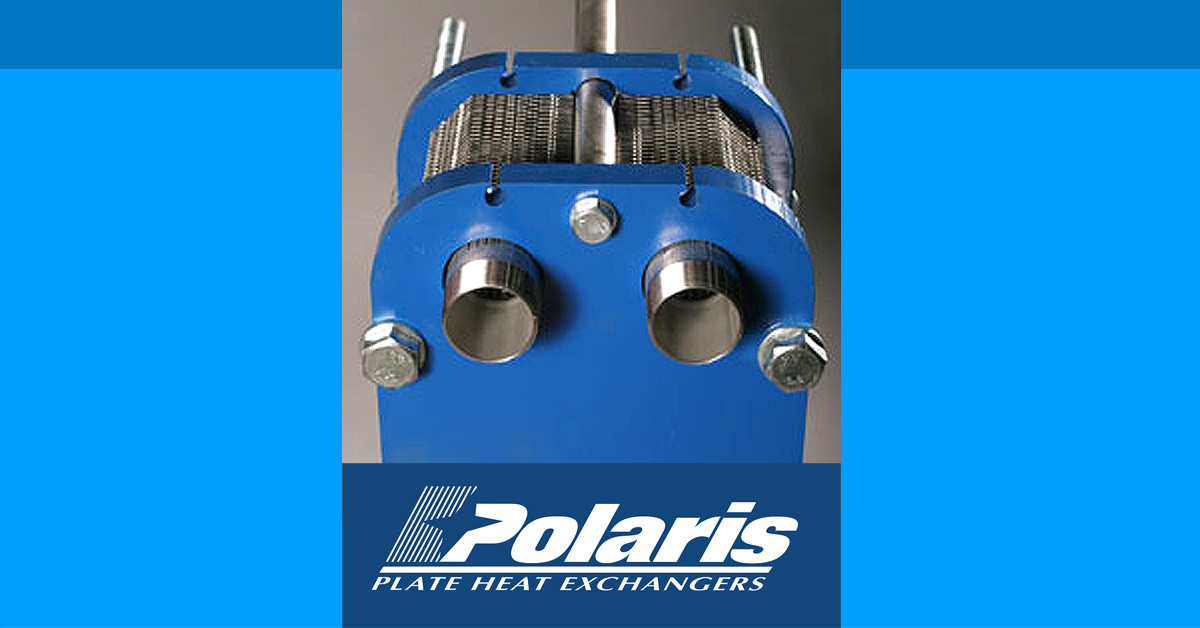
The plate stack is clamped between a fixed frame plate and a movable pressure plate, with gaskets sealing the flow channels between plates and directing each fluid to its designated channels. The entire assembly can be opened by loosening the clamping bolts, which provides direct access to every heat transfer surface for inspection and cleaning.
Where PHE outperforms shell and tube
The thermal efficiency advantage is the most significant difference between plate and shell and tube heat exchangers for the same duty. A plate heat exchanger achieves a much higher overall heat transfer coefficient than a shell and tube exchanger of equivalent size because the corrugated plate geometry creates turbulent flow at low velocities. The practical result is that a plate heat exchanger can achieve the same heat transfer duty in a significantly smaller footprint than a shell and tube equivalent.
For mechanical rooms where space is constrained, the footprint difference is directly relevant to what can be installed. A plate heat exchanger that occupies one-quarter the floor space of a shell and tube equivalent is not a marginal advantage in a mechanical room where every square foot has competing uses.
The close temperature approach is the second significant advantage. A plate heat exchanger can achieve approach temperatures of one to two degrees Fahrenheit between the two fluid streams. A shell and tube exchanger typically achieves approach temperatures of five to ten degrees Fahrenheit under equivalent conditions. For applications where the heat transfer duty requires a close temperature approach, a plate heat exchanger can meet the specification where a shell and tube cannot without a significant increase in size.
Cleanability is the third advantage for applications where fouling is a concern. The gasketed plate design opens completely for mechanical cleaning. Every plate surface is accessible. A shell and tube heat exchanger requires tube brushing or chemical cleaning procedures that are more time-consuming and less thorough. For applications in food processing, pharmaceutical, or any facility where the heat exchanger serves a process that requires documented cleaning, the plate design is significantly easier to verify and certify as clean.
Where shell and tube remains the better choice
Plate heat exchangers have limitations that make shell and tube the better specification in certain applications.
High pressure applications are the primary limitation. Gasketed plate heat exchangers are typically limited to operating pressures below 300 PSI depending on the model and gasket material. Shell and tube heat exchangers can be designed for operating pressures in the thousands of PSI for high-pressure industrial applications. For applications where system pressure exceeds the plate heat exchanger’s design range, shell and tube is the correct specification.
High temperature applications present similar constraints. Gasket materials limit the maximum operating temperature of gasketed plate heat exchangers. Brazed plate heat exchangers eliminate the gasket limitation and extend the temperature range, but at the cost of the cleanability advantage since a brazed unit cannot be opened.
Applications with very large temperature differentials between the two fluid streams can favor shell and tube because the differential thermal expansion between the shell and tubes can be managed through the design of the exchanger. In a plate heat exchanger, large differential expansion can stress the gaskets and frame.
For applications where the two fluids cannot under any circumstances come into contact, a double-wall plate or a shell and tube design with double tube sheets is required. Standard single-wall plate heat exchangers provide a single barrier between the two fluid streams.
Building isolation and free cooling applications
Two applications where plate heat exchangers have become the standard specification in commercial HVAC are building isolation and free cooling.
Building isolation uses a plate heat exchanger to hydraulically separate a building’s internal hydronic system from the campus or district energy distribution system. The building side operates at lower pressure than the distribution system, protecting the building’s internal equipment from the higher distribution pressure. The plate heat exchanger provides efficient heat transfer across the pressure boundary with the close temperature approach that minimizes the efficiency penalty of the isolation step.
Free cooling uses a plate heat exchanger to transfer heat from the building’s chilled water system to the cooling tower water circuit when ambient conditions allow the cooling tower to provide cooling without running the chillers. The close temperature approach of the plate heat exchanger maximizes the number of hours per year when free cooling is available, which reduces chiller runtime and energy consumption.
Polaris PHE through Merion Pump
Merion Pump Company carries the Polaris PHE plate heat exchanger line for commercial and industrial applications. The Polaris line covers gasketed plate heat exchangers for HVAC, building isolation, free cooling, and process applications across the capacity range relevant to commercial and institutional buildings.
For applications where a plate heat exchanger is part of a larger packaged mechanical system, the FabPro Systems team integrates PHE units into factory-assembled packages with pumps, controls, and piping. Visit fabprosystems.com for more on FabPro’s heat transfer skid capabilities. For applications where the process side of the heat exchanger involves custom coil fabrication, the HX Coils team handles the coil specification. Visit hxcoils.com for more.
References
1. ASHRAE. HVAC Systems and Equipment Handbook, Chapter on Heat Exchangers. Covers plate heat exchanger design, selection, and application guidance for commercial HVAC. ashrae.org
2. Hydraulic Institute. Heat Exchanger Selection Guide. Covers selection criteria for plate versus shell and tube configurations in commercial and industrial applications. pumps.org
3. TEMA. Standards for Shell and Tube Heat Exchangers. Provides the design and fabrication standards that define shell and tube heat exchanger capabilities for comparison. tema.org
4. International District Energy Association. Campus Energy Systems Design Guide. Covers building isolation and free cooling applications for plate heat exchangers. districtenergy.orgg