
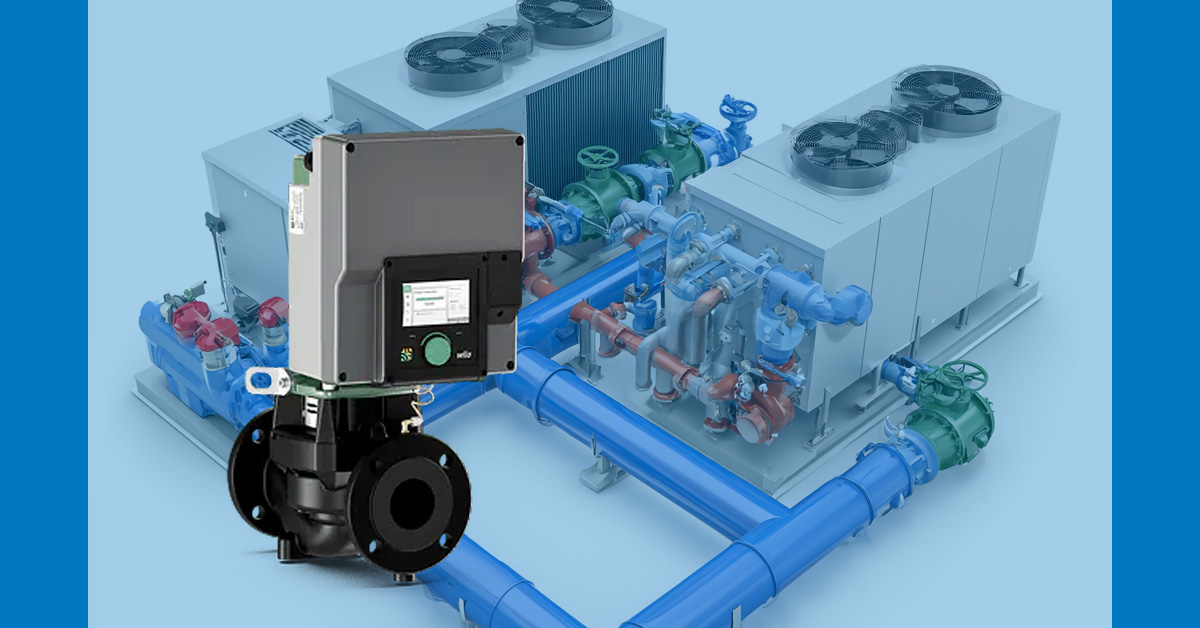
Tandem chillers and how pumping configuration affects system performance.
A tandem chiller system is one of the more common configurations in medium to large commercial cooling plants, and one of the more frequently misunderstood from a pumping standpoint. Two chillers operating in parallel to serve a common chilled water distribution system seems straightforward until the pumping configuration gets involved. Get the pumping wrong and the chillers do not perform the way the specification predicted, the controls hunt for a stable operating point, and the energy consumption runs higher than it should across the full range of building load conditions.
Getting it right requires understanding how the pumping system interacts with the chillers, not just how each component performs in isolation. This article covers what engineers and building owners need to know about tandem chiller pumping before the system is specified.
What a tandem chiller system is
A tandem chiller arrangement uses two chillers connected in parallel to a common chilled water supply and return header. The two chillers share the cooling load, with each unit serving a portion of the total building demand. In a typical tandem arrangement, each chiller is sized for roughly half the peak design load, allowing the plant to operate one chiller at part load during periods of reduced demand rather than running a single larger chiller at very low load conditions where efficiency suffers.
The efficiency advantage of the tandem arrangement depends on the ability to match the number of operating chillers and their individual part-load operating points to the actual building load at any given time. That matching is a controls and pumping problem as much as it is a chiller selection problem.
Primary-secondary pumping and why it matters for tandem chillers
The most common pumping configuration for tandem chiller systems is primary-secondary. In a primary-secondary arrangement, the primary pumps are dedicated to the chiller evaporator circuits and maintain the flow rate required by each chiller through its evaporator. The secondary pumps serve the distribution system and vary their flow rate in response to the building load.
The primary and secondary circuits are hydraulically decoupled by a common pipe, sometimes called a decoupler or a bypass pipe, that connects the supply and return headers between the two circuits. The decoupler allows the primary circuit to maintain constant flow through the chiller evaporators while the secondary circuit varies its flow in response to the building load. This decoupling is what allows the tandem chiller arrangement to operate efficiently across the full range of load conditions.
Without correct hydraulic decoupling, the variable flow in the secondary circuit affects the flow through the chiller evaporators directly. Most chillers have a minimum evaporator flow requirement below which the chiller cannot operate correctly. If secondary circuit flow drops below the minimum primary flow requirement, the chiller experiences low-flow conditions that trigger safety shutdowns or cause control instability. The decoupler prevents this by providing a path for excess primary flow to bypass the secondary circuit when building demand is low.
Chiller minimum flow requirements and pump selection
Each chiller manufacturer specifies a minimum evaporator flow rate below which the chiller cannot operate correctly. In a tandem arrangement with primary-secondary pumping, the primary pump for each chiller needs to maintain at least the minimum flow rate through the evaporator at all times when that chiller is operating. The primary pump selection should be based on the chiller’s design flow rate at full load and confirmed against the minimum flow requirement to ensure the pump can maintain adequate flow across its full operating range.
Variable speed primary pumping is increasingly common in modern chiller plant designs and can reduce energy consumption in the primary circuit. However, variable speed primary pumping requires careful coordination with the chiller manufacturer to confirm that the minimum flow requirement can always be met under all operating conditions, including during chiller startup and at minimum load. A variable speed primary pump that reduces flow below the chiller’s minimum during low-load operation will cause the chiller to fault in ways that are difficult to diagnose without understanding the interaction between the pump and the chiller controls.
Secondary pump selection and variable flow distribution
The secondary pumps in a tandem chiller system are the pumps that serve the building distribution system. They are almost always variable speed in modern designs, responding to differential pressure setpoints that reflect the actual demand in the distribution system. Correct secondary pump selection requires understanding the system curve of the distribution system, the control strategy for differential pressure setpoint reset, and the interaction between the secondary pump operation and the chiller staging controls.
A secondary pump that is oversized for the distribution system will operate far down its curve at typical building loads, consuming more energy than a correctly sized pump and potentially causing control instability in the distribution system. A secondary pump that is undersized will not meet peak load conditions. The selection needs to be based on the actual distribution system characteristics, not on a rule of thumb or a preliminary design estimate.
Differential pressure setpoint reset is worth specific attention. A fixed differential pressure setpoint sized for design conditions keeps the secondary pump running at higher speeds than necessary during the majority of operating hours when the building is not at peak load. A reset strategy that adjusts the setpoint based on the most demanding zone valve position reduces pump energy consumption significantly across the annual operating profile. The secondary pump needs to be selected for the reset strategy that will actually be implemented in the controls, not for a fixed setpoint that may not reflect how the system will be operated.
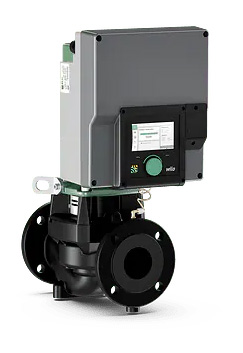 The Wilo Stratos GIGA2.0-I for chiller plant applications
For secondary pumping in tandem chiller plant applications, the Wilo Stratos GIGA2.0-I is worth specific attention. Launched in 2025, it is Wilo’s current high-efficiency vertical in-line pump for commercial HVAC applications and brings a set of capabilities directly relevant to chiller plant operation.
The Stratos GIGA2.0-I delivers up to 702 GPM and 153 feet of head with an IE5 electronically commutated motor. In a chiller plant secondary circuit, the relevant performance features are the Dynamic Adapt plus control function, which automatically identifies and operates the pump at its optimal efficiency point in response to actual system demand without requiring a fixed setpoint, and the Multi-Flow Adaptation function, which enables communication between multiple pumps so the system can holistically balance flow across the distribution circuit. The Q-Limitmin function allows the engineer to set a minimum flow limit that prevents the pump from dropping below the flow rate required to maintain chiller evaporator protection, which is directly relevant in variable flow primary applications.
For building automation integration, the Stratos GIGA2.0-I supports Modbus, BACnet, and other protocols through plug-in CIF modules, allowing direct integration with the BAS for setpoint adjustment and operating data monitoring. The Bluetooth interface and Wilo-Smart Connect app support commissioning and ongoing diagnostics without requiring wired connections to the controls cabinet.
Merion Pump Company represents Wilo across the full commercial HVAC product line. For tandem chiller plant applications, the Stratos GIGA2.0-I is a strong candidate for the secondary circuit. Reach out to the Merion Pump team and we will confirm the selection against your specific distribution system curve and controls strategy.
Staging logic and its effect on pump operation
In a tandem chiller system, the decision of when to stage a second chiller on or off is a controls decision with direct implications for pump operation. Staging a second chiller on requires starting the second chiller’s primary pump and confirming evaporator flow before the chiller is allowed to start. Staging a chiller off requires confirming that the remaining chiller can handle the load before the second chiller and its primary pump are shut down.
If the staging logic does not correctly account for the primary pump startup and shutdown sequence, the result is chiller faults during staging transitions that interrupt cooling delivery and generate nuisance alarms. Getting the staging logic right requires coordination between the chiller controls, the primary pump controls, and the building automation system, and it is best addressed during the design phase rather than during commissioning when the system is already installed.
What Merion Pump brings to the conversation
When a chiller plant application comes to Merion, the pump selection conversation covers the full system, not just the pump curves. Primary pump selection against each chiller’s evaporator flow requirements. Secondary pump selection against the actual distribution system curve and the control strategy for differential pressure reset. Decoupler sizing to confirm hydraulic separation between the primary and secondary circuits. Coordination of the pump selection with the staging logic requirements.
For chiller plant applications that include plate heat exchangers on the condenser water side or in the chilled water distribution system, the HX Coils team handles the heat exchanger specification. Visit hxcoils.com for more on HX Coils’ custom heat exchanger capabilities. For chiller plant pump systems that benefit from a factory-assembled skid configuration, the FabPro Systems team designs and fabricates custom pump skids for chiller plant applications. Visit fabprosystems.com for more on FabPro’s packaged pump system capabilities.
References
1. ASHRAE. HVAC Systems and Equipment Handbook, Chapter on Centrifugal Chillers. Covers chiller selection, evaporator flow requirements, and chiller plant configurations. ashrae.org
2. Hydraulic Institute. Pump System Optimization Guide. Covers primary-secondary pumping, variable flow systems, and differential pressure setpoint reset. pumps.org
3. Wilo USA. Wilo Stratos GIGA2.0-I product page and launch announcement. Up to 702 GPM and 153 feet of head, IE5 motor, Dynamic Adapt plus, Multi-Flow Adaptation, and BAS integration via CIF modules. wilo.com/us
4. Taylor Engineering. Fundamentals of Design and Control of Central Chilled-Water Plants. Comprehensive reference for chiller plant design including pumping configuration and staging logic. taylor-engineering.com
5. ASHRAE. Advanced Energy Design Guide for Large Hospitals. Covers chiller plant efficiency requirements and pumping system design for healthcare applications. ashrae.org
All technical claims are consistent with the standards and references listed above. Confirm chiller manufacturer minimum flow requirements and controls coordination requirements with the equipment manufacturer before finalizing the specification.