
Fiberglass cooling towers vs steel: what engineers need to know before specifying.
When a cooling tower specification lands on an engineer’s desk, the default assumption is often galvanized steel. Steel cooling towers have dominated the commercial and industrial market for decades. They are familiar, they are widely available, and most engineers have specified them before. Fiberglass cooling towers, by contrast, are still frequently treated as the specialty option, the choice for unusual applications or engineers who have done their homework on alternatives.
That framing is becoming harder to justify. The engineering case for fiberglass reinforced polymer in commercial and industrial cooling tower applications is not marginal. It is material, it affects the full life cycle of the installation, and it is the kind of comparison that belongs in the specification conversation before the equipment is selected, not after the first major repair bill arrives.
This article covers the comparison engineers need to make before the spec is written.
The core material difference and why it matters
Galvanized steel cooling towers are built from steel coated with a zinc layer that provides corrosion protection. The zinc sacrificially corrodes to protect the underlying steel, which means the protective layer is consumed over time. In the wet, chemically active environment inside a cooling tower, that process accelerates. Water treatment chemistry, biological growth control, and the minerals in the makeup water all affect how quickly the galvanized coating degrades. Once the coating is compromised, the steel beneath corrodes directly.
Aluminum cooling towers face similar dynamics. Aluminum is naturally corrosion resistant in many environments but is susceptible to attack from certain water chemistry conditions, particularly in systems with aggressive pH or where dissimilar metals are in contact in the water circuit.
Fiberglass reinforced polymer does not corrode in the same way. The material is inherently resistant to the chemical environment inside a cooling tower, including the range of water chemistry conditions typical in commercial HVAC and industrial process applications. There is no coating to degrade and no underlying metal to expose. The structural integrity of an FRP tower is not diminished by the same corrosion mechanisms that limit the service life of steel and aluminum alternatives.
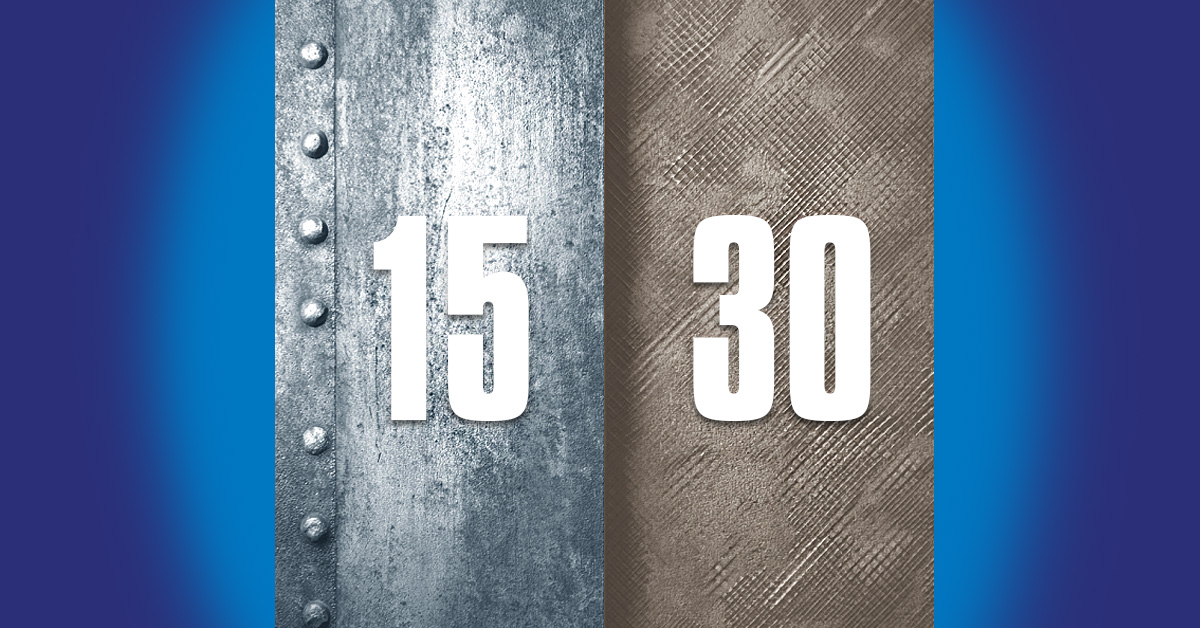
That difference translates directly into service life. A well-maintained steel cooling tower in a commercial HVAC application typically reaches the end of its useful life in 15 to 20 years, sometimes less in harsh environments or where water treatment has been inconsistent. FRP cooling towers from manufacturers with proven designs are rated for service lives exceeding 30 years. That is not a marginal improvement. It is a fundamental change in the long-term economics of the installation.
Structural and weight considerations
Steel is heavy. The structural loading requirements for a rooftop cooling tower installation are determined by the weight of the equipment, and steel towers require more structural support than FRP alternatives of equivalent capacity. On new construction this affects the roof structure design. On retrofit and replacement projects it can become a constraint that limits which replacement options are feasible without structural modifications.
FRP is significantly lighter than steel for equivalent capacity. That weight reduction has direct implications for rooftop structural loading, for the complexity and cost of the supporting structure, and for the rigging and installation process. An FRP tower that can be placed by a smaller crane or lifted without specialized rigging reduces both the direct cost and the scheduling complexity of the installation.
The structural advantage compounds in seismic zones and coastal installations where wind and seismic loading requirements add to the structural demands on both the tower and its supporting structure. Lighter equipment means lower demands on the support structure across all loading conditions.
Maintenance profile over the life of the installation
This is where the engineering comparison most directly affects the facility manager’s experience of the equipment over time. Steel cooling towers require regular inspection for corrosion, particularly at the basin, the structural members, and any areas where coating damage has occurred. Repairs to corroded sections are expensive, disruptive, and in older towers often become a recurring cost that the original specification budget did not account for. Basin replacements on aging steel towers are a common maintenance expense that effectively becomes a second major investment in equipment that should have been replaced.
FRP towers require maintenance, but the maintenance profile is different. The fill media, nozzles, drift eliminators, and fans need attention on the same schedule as any cooling tower. What does not need attention is progressive corrosion of the structure and basin, because the material does not corrode in the way steel does. The maintenance budget for an FRP tower over its service life reflects the mechanical and hydraulic components, not a structural remediation program.
“The service life comparison is where the specification decision becomes clear. An FRP tower that performs reliably for 30 years without structural corrosion remediation is a fundamentally different investment than a steel tower that requires significant maintenance intervention at year 12 and replacement at year 18.”
Water conservation and chemical treatment
Water consumption and chemical treatment costs are increasingly relevant to commercial and industrial facility operators, both for operational cost reasons and for sustainability reporting requirements. The design of the cooling tower affects both.
Steel towers require water treatment chemistry calibrated to protect the metal surfaces in the system. The treatment program has to balance corrosion inhibition, scale control, and biological growth control against the limitations of the metal materials in the circuit. FRP construction simplifies the treatment requirements by removing some of the metal-specific corrosion concerns from the equation.
Closed-circuit FRP cooling tower designs available from current manufacturers take this further by eliminating the contact between the process fluid and the atmospheric air and evaporative water circuit entirely. In these configurations the process fluid circulates in a closed coil inside the tower and exchanges heat with the evaporative water circuit without direct contact. Water consumption is significantly reduced compared to open-circuit designs, and the process fluid is protected from airborne contamination. For applications where process fluid purity is a design requirement, the closed-circuit FRP configuration is often the correct answer regardless of other considerations.
Where the FRP case is strongest
The engineering case for FRP over steel is compelling across a wide range of commercial and industrial applications. It is particularly strong in four situations.
Long-term installations where the 30-year service life difference translates into a meaningful lifecycle cost advantage. If the facility has a 25-year planning horizon, the choice between a steel tower that may need replacement within that window and an FRP tower that should not is a decision with significant financial consequences.
Rooftop installations where structural loading is a constraint. The weight advantage of FRP is directly relevant when the roof structure is a limiting factor.
Coastal and industrial environments where aggressive atmospheric conditions accelerate corrosion in steel towers. FRP’s corrosion resistance is most valuable in the environments where steel is most vulnerable.
Data center and mission-critical applications where uptime requirements are non-negotiable. Multi-fan FRP tower designs that remain operational when individual fans require service provide a level of redundancy that is built into the product design rather than specified as an add-on.
What the specification should capture
Engineers specifying cooling towers should confirm the following before the equipment selection is finalized. The material specification, FRP or steel or aluminum, with the rationale documented. The expected service life against the facility’s planning horizon. The structural loading requirements and whether the tower weight is a constraint. The water treatment program requirements and whether closed-circuit configuration is appropriate for the application. The certification requirements, including whether FM approval for fire safety is required for the installation.
Merion Pump Company carries Tower Tech cooling towers across the full FRP product line, including open-circuit, closed-circuit evaporative, and hybrid fluid cooler configurations. If you have a cooling tower specification in development and want to work through the material and configuration comparison before the equipment is selected, reach out to the Merion Pump team.
References
1. Cooling Technology Institute. CTI Standard STD-201. Governs the testing and performance certification of cooling towers. cti.org
2. Tower Tech Inc. Product specifications and application guidance for FRP cooling tower product line including TTXL, TTXR, TTCC-FC, and TTCC-HC configurations. towertechusa.com
3. ASHRAE. HVAC Systems and Equipment Handbook, Chapter on Cooling Towers. Covers cooling tower types, selection criteria, and maintenance considerations. ashrae.org
4. NFPA 214. Standard on Water-Cooling Towers. Governs fire protection requirements for cooling towers including materials and construction. nfpa.org
5. CompositesWorld. Tower Tech expands modular FRP cooling towers lineup. March 2025. compositesworld.com