
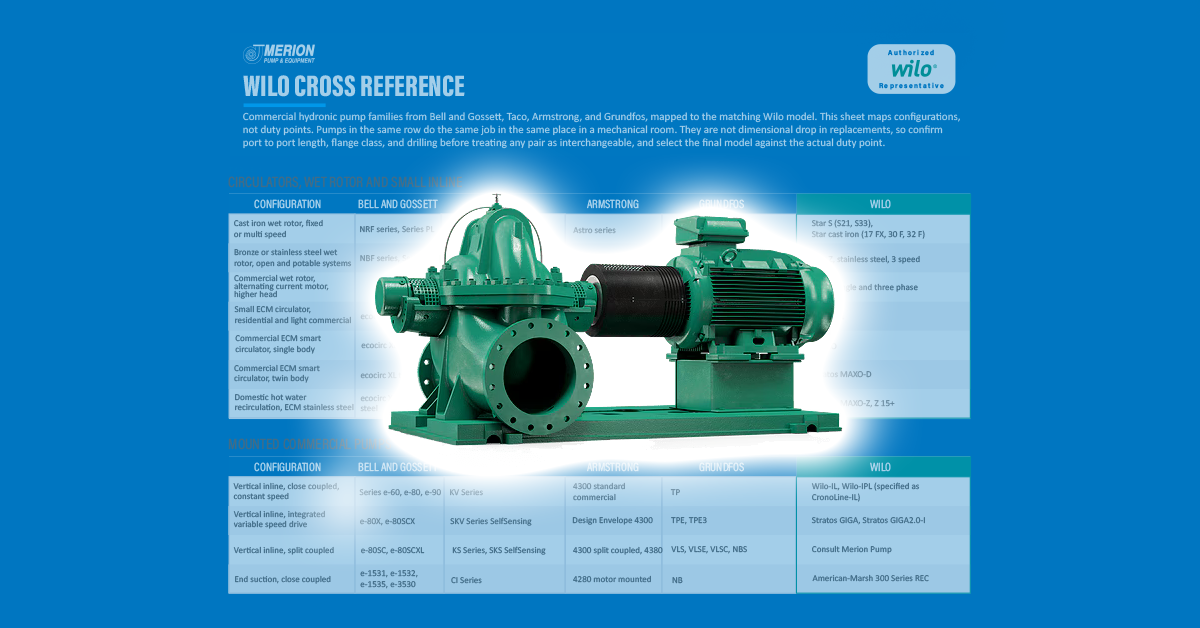
Wilo cross-reference: finding the Wilo model that does the same job as the pump already on the drawings.
A pump schedule rarely starts from scratch. More often, the engineer or contractor has an existing pump on the drawings, and the question is which Wilo model does the same job in the same place. The answer is faster to find if you start with the application instead of the model number.
How the cross-reference works
The Merion Pump cross-reference maps commercial hydronic pump families that engineers already specify to the matching Wilo model. It is organized by configuration: cast iron wet rotor, bronze and stainless wet rotor for open and potable systems, small ECM circulators, commercial ECM smart circulators in single and twin body, vertical inline, end suction, double suction split case, vertical multistage, and packaged domestic water boosters.
Pumps in the same row do the same job in the same place in a mechanical room. A single body ECM circulator crosses to the Stratos MAXO. A twin body crosses to the Stratos MAXO-D. A vertical inline with an integrated variable speed drive crosses to the Stratos GIGA. A double suction split case crosses to the Wilo SCP.
What the sheet does not tell you
The cross-reference maps configurations, not duty points. Pumps in the same row are not dimensional drop-in replacements. Before treating any pair as interchangeable, confirm the port to port length, flange class, and drilling. Then select the final model against the actual duty point: flow, head, and operating range.
A hatched cell means no directly comparable Wilo model family was identified at the time of printing. It does not confirm that none exists, so ask us before assuming there is no match.
Family ranges for a quick screen
The sheet also lists the maximum range of each Wilo family, which is useful for ruling models in or out. Examples: Stratos MAXO to 280 GPM and 52 feet of head, Stratos GIGA to 550 GPM and 167 feet, Wilo NL-HE base mounted end suction to 3,000 GPM and 475 feet, and Wilo SCP split case to 5,000 GPM and 180 feet. These are family maximums, not simultaneous values. The flow and head at any single operating point depend on the selected model, impeller, and motor.
A practical order of operations
Start with the configuration on the existing pump schedule. Find the matching row. Pull the Wilo model, then check the family range against the duty point. Confirm the physical fit. Then ask for a selection and submittal on the final model.
Do this early in the project. A cross-reference done at submittal time leaves no room to resolve a flange or footprint question.
For skids built for tight mechanical rooms, FabPro Systems covers that in today’s article. Visit fabprosystems.com for more. For hot water coils on the same plant, HX Coils covers coil piping in today’s article. Visit hxcoils.com for more.
Send the existing pump schedule to Merion Pump and we will cross it to Wilo, then help with selection and submittals.
References
1. Merion Pump Company. Wilo Cross-Reference Tool. merionpump.com
2. Wilo North America. 60 hertz product guide, family performance ranges. wilo.com