
Wilo for mechanical contractors: what you need to know about selecting, installing, and commissioning Wilo pumps on a commercial job.
Mechanical contractors who have worked primarily with one or two pump brands on commercial hydronic jobs sometimes encounter Wilo for the first time when an engineer specifies it or when a building owner requests it based on a product they have seen in a presentation. This article covers what a mechanical contractor needs to know about Wilo products to install and commission them correctly on a commercial job, and what is different about Wilo compared to the products most contractors have worked with before.
The wet rotor circulator difference
Most mechanical contractors are familiar with small circulators where the motor sits outside the pump housing on a separate bracket with a shaft coupling between them. In a Wilo wet rotor circulator, the motor rotor is immersed directly in the fluid being pumped. There is no mechanical seal, no shaft coupling, and no external motor bearings exposed to the environment.
The practical difference for installation is that a wet rotor circulator is lighter and more compact than a comparable dry rotor pump, it requires no alignment check between the pump and motor, and it has no seal or coupling to inspect during commissioning. What it does require is that the system be filled and purged of air before the circulator is started, because the fluid being pumped cools the motor. A wet rotor circulator started dry will overheat. This is the most common commissioning error on wet rotor installations and it is easy to prevent by confirming the system is filled and pressurized before powering the pump.
Stratos MAXO installation and commissioning
The Stratos MAXO is the ECM smart circulator that Merion Pump installs on commercial hydronic jobs. Single pump, dual pump on a single volute, and NSF 61 certified potable water versions are available. The installation footprint is the same as a conventional circulator at the same connection size, and the flange connections are standard.
At first power-up the MAXO defaults to Dynamic Adapt Plus mode, which means it begins measuring the relationship between pressure and flow in the system and automatically adjusts its operating point over the first several days of operation. Contractors who commission the pump and immediately check the operating differential pressure against a design target may find the pump running at a different setpoint than they expect. This is normal. The pump is learning the system. After several days of operation it will have settled at an efficient operating point for the actual system conditions.
The green button interface on the front of the pump is the primary operator control. Press once to wake the display, hold for three seconds to enter the settings menu. The Wilo Assistant app provides Bluetooth access to pump settings and operating data from a phone or tablet without a ladder, which is useful for pumps installed at height in a mechanical room. The BACnet MSTP, BACnet IP, and Modbus communication modules install with two Phillips head screws behind the display screen and require no tools beyond a small screwdriver.
For contractors commissioning a Stratos MAXO in a system with a building automation system integration requirement, confirm the communication module type with the BAS contractor before the pump is installed so the correct module is on hand at startup. Changing the module after the pump is installed and wired is straightforward, but having the right module at first startup avoids a second mobilization.
Stratos GIGA 2.0 and larger inline pumps
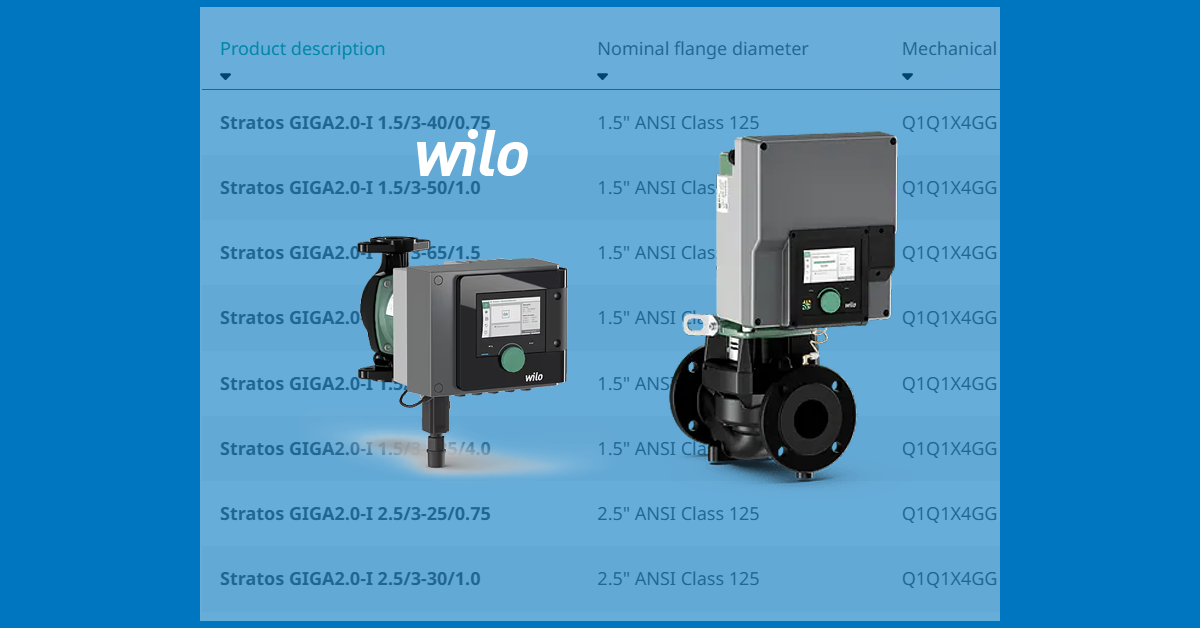
The Stratos GIGA 2.0 is the ECM vertical inline pump for larger commercial hydronic applications. It uses the same control interface as the MAXO, so contractors who have commissioned a MAXO will find the GIGA 2.0 controls familiar. The pump is a vertical inline configuration with standard ANSI flange connections and a close-coupled motor that does not require field alignment.
For contractors who have primarily worked with base-mounted end suction pumps, the vertical inline configuration means the pump and motor assembly is supported by the pipe flanges rather than by a base and motor mount. The pipe flanges and the supporting pipework need to be installed correctly before the pump is set, and the pipework needs to be adequately supported so the pump flanges are not carrying the pipe load. This is standard mechanical practice for vertical inline pumps but worth confirming on the rough-in before the pump arrives.
What Merion Pump provides to contractors
Merion Pump provides Wilo product submittals, installation instructions, commissioning checklists, and technical support for contractors working on Wilo jobs in the territory. For jobs where a Wilo pump is being substituted for a specified product from another manufacturer, Merion Pump provides the substitution documentation the contractor needs to get the substitution approved.
For contractors encountering Wilo for the first time on a job, a pre-installation conversation with the Merion Pump team before the pump arrives on site saves time at startup. We can walk through the specific model’s installation requirements, the commissioning sequence, and any job-specific considerations before the contractor is standing in the mechanical room with the pump in hand.
For boiler plant applications where the Wilo pump system needs to be coordinated with the boiler startup sequence, the GP Energy Products team handles the boiler side and can coordinate the startup with Merion Pump. Visit gpenergyproducts.com for more. For packaged systems where the Wilo pump is pre-installed in a FabPro skid, the commissioning documentation comes with the skid and the FabPro team coordinates the startup sequence. Visit fabprosystems.com for more.
References
1. Wilo USA. Installation, operation, and maintenance documentation for Stratos MAXO, Stratos GIGA 2.0, and commercial inline pump product lines. wilo.com
2. Hydraulic Institute. Pump Installation, Operation, and Maintenance Standards. Covers installation requirements for wet rotor circulators and vertical inline pumps in commercial hydronic applications. pumps.org
3. ASHRAE. HVAC Systems and Equipment Handbook, Chapter on Pumps. Covers commercial hydronic pump installation, commissioning, and startup requirements. ashrae.org
4. NSF International. NSF/ANSI Standard 61. Covers potable water certification requirements applicable to Wilo MAXO-Z installation in domestic hot water recirculation applications. nsf.org